
01
Two objects, and the difference that matters
It is not strength. Both can be made strong enough. The difference is whether the attachment lets the sling change direction while the load turns.
A trunnion is a stub, usually a piece of pipe, welded to the side of a vessel. The sling or the bail wraps around it and bears directly on its outer surface. Nothing constrains where the sling sits along it, and nothing constrains the direction the sling pulls: the trunnion is a bearing surface, and a sling on it can swing through a wide arc as the load rotates.
A padeye is a plate with a hole, and the sling reaches it through a shackle pin. The pin fixes where the force is applied and, within the shackle's tolerance, the direction it comes from. A padeye is a directional attachment.
Everything else follows from that.
01Does the load rotate during the operation?
- Yes - it is upended, tailed or turned
- A trunnion, almost always. The sling angle sweeps through tens of degrees. A padeye would be loaded far out of its plane at the extremes, which is the load case padeyes are worst at.
- No - it is picked and set the same way up
- A padeye is usually simpler and lighter. A known direction lets the plate be oriented to it, which is the whole efficiency of a padeye.
02What is it welded to?
- A pressure vessel shell
- The shell governs, whichever attachment you pick. Local shell stress from an external attachment loading is the check that decides this, and no lifting standard supplies it.
- A structural member or a thick plate
- The attachment and its weld usually govern. Local plate bending still needs a check, and it is still somebody's job to do it.
03Can the sling bear directly on it?
- Yes, with an established contact capacity
- A trunnion works and its contact band is a real check. The capacity is evidence you supply. A trunnion is not automatically capable of the contact stress a sling puts on it.
- No, or the sling would be damaged
- A padeye with a shackle, or a trunnion with a bail. A bail turns the contact question back into a pin question and adds a component to design.
02
What a trunnion is actually checked for
Four families, and the one that governs is not the trunnion. The steel stub is usually the easiest part of the calculation.
A trunnion on a vessel needs:
The trunnion as a cantilever. Bending and shear at its root, from the sling force acting at the contact centroid out along the projection. Straightforward mechanics on a hollow section.
- is bending at the root, from the sling force acting out at the contact centroid
- is the section modulus of the hollow stub, and J its torsion constant
These are the calculator's own expressions, so the report opens on the same symbols. The steel stub is the easy part: it is the shell behind it, and the sling bearing on it, that decide the answer.
The attachment weld. The trunnion-to-shell weld, carrying the same actions.
The local shell stress. The concentrated force and moment the trunnion delivers into a curved thin shell. This is a pressure-equipment calculation, not a lifting one, and it is where the answer usually is.
The sling contact. The bearing stress where the sling wraps the trunnion, and the ovalising effect of that band on the trunnion wall. This one has no general closed form and needs an established capacity.
Lifting Trunnion Design Calculator
Full sizeOpen these inputs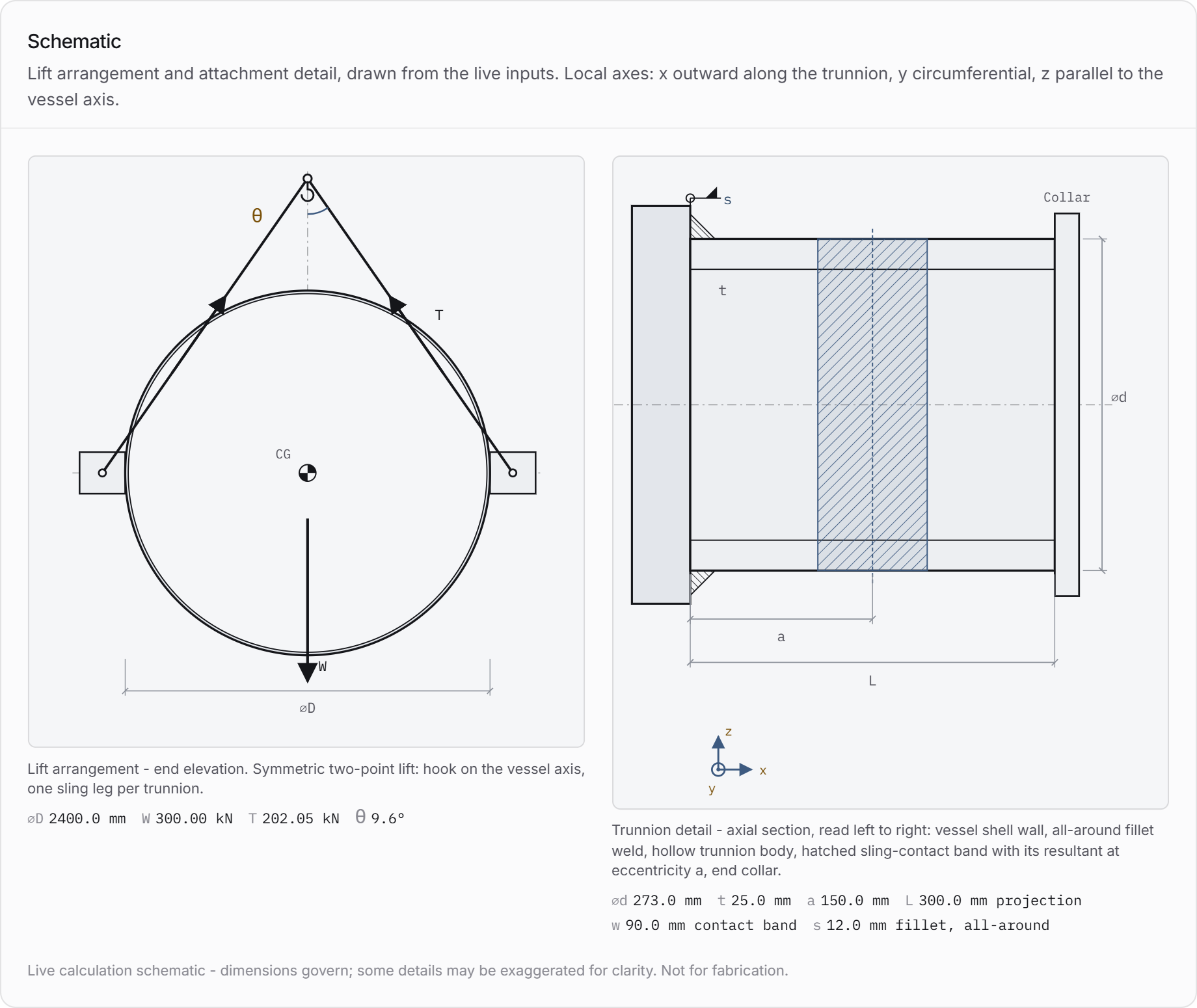
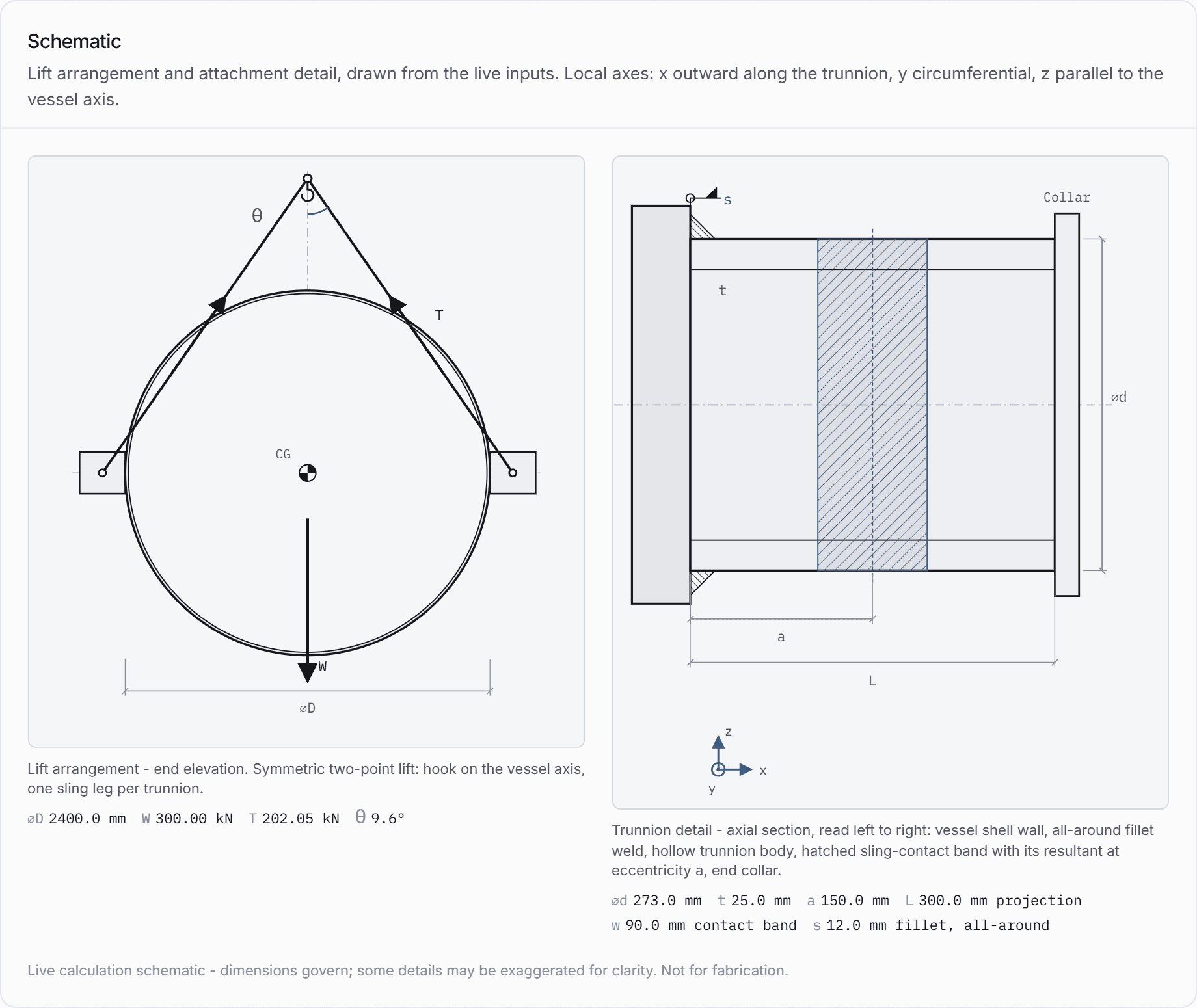
Lifting Trunnion Design Calculator · computed at page render
A trunnion on a 2.4 m vessel, 30 t gross
One of a pair of trunnions near the top of the vessel, with the calculator's own factors on the demand.
| Trunnion root, combined stressthe steel stub itself | 21.3% |
|---|---|
| Attachment weld, fillet throat | 46.3% |
| Weld allowable, below-the-hook route | 80.5% |
| Local shell acceptancethe vessel, not the trunnion - failed | 180.7% |
| Sling contact and ovalisationagainst a declared contact capacity - failed | 132.8% |
Read the first row against the fourth. The trunnion is at a fifth of its capacity and the vessel it is welded to is at nearly twice. A calculation that stopped at the attachment would have reported a comfortable design.
Open this example in the calculator03
What it takes to make it work
A thicker shell and a contact capacity somebody established. Neither of those is a change to the trunnion, and neither is the lifting engineer's to make.
Lifting Trunnion Design Calculator · computed at page render
The same trunnion on a thicker shell
The shell goes from 20 mm to 32 mm, and the sling contact capacity is established by assessment rather than assumed. The trunnion is untouched.
| Shell thicknessagainst 20 mm | 32mm |
|---|---|
| Local shell acceptanceagainst 180.7% | 76.1% |
| Sling contact and ovalisationagainst an established capacity | 62.3% |
| Trunnion root, combined stressunchanged | 21.3% |
| Weld allowable, below-the-hook routenow governing | 80.5% |
Passing, with the weld governing. Both changes were somebody else's: the shell thickness belongs to the vessel designer and the contact capacity to whoever produces the assessment. A lifting engineer who can only change the trunnion cannot fix this problem.
Open this example in the calculatorTwo general lessons come out of that.
A trunnion is a request, not a design. Putting one on a vessel asks the vessel to accept a concentrated load in a place it was not necessarily designed for. That request has to be made early enough for the shell to be thickened, a pad added, or the position moved.
A reinforcing pad changes the evidence, not just the numbers. The published local-stress method is for the unreinforced attachment. Add a pad and the automatic calculation no longer applies, so the shell assessment becomes an analysis somebody has to produce and reference. That is a schedule item, not a detail.
04
The padeye on the same vessel, at the same demand
Every check comfortable, and no shell check at all. The absence is not a result, and reading it as one is the most consequential mistake in this article.
Lifting Lug Calculator · computed at page render
A padeye at the same per-attachment demand
199.2 kN at 15 degrees off the plate axis, which is the trunnion case's own factored share. Public-domain mechanics against declared allowables.
| Demand | 199.2kN |
|---|---|
| Net-section tension | 17.1% |
| Double-plane shear-out | 48.2% |
| Pin bearing on the lug | 38.4% |
| Fillet weld throat resultant | 45.5% |
| Local shell stressa padeye calculation has no shell check in it | not checked |
Comfortable on every mechanics check, and the vessel has not been mentioned. Open the example and the below-the-hook cross-check reads higher on the weld, which is a reminder that the route is a declaration too. But the absence that matters is the shell: a padeye welded to one delivers a concentrated force and a moment exactly as a trunnion does, and that assessment is not in a padeye calculation at all, so it has to be somebody's explicit job.
Open this example in the calculatorA padeye on a vessel is a pressure-equipment attachment before it is a lifting accessory. The lifting calculation checks the plate, the pin and the weld. The shell is a separate assessment against the pressure-equipment code, using an accepted local-stress method, and it is required whether the attachment is a stub or a plate.
05
Choosing between them
Rotation first, then the shell, then the sling. Strength is rarely the deciding question because both can be made strong.
Choose a trunnion when the load rotates. Upending, tailing, turning a vessel to horizontal for transport. The sling has to be free to change direction through tens of degrees, and only a bearing surface allows that.
Choose a padeye when the direction is known and fixed. It is lighter, easier to inspect, and it can be oriented to the sling, which is the whole reason it is efficient.
Choose a trunnion when you cannot accept a shackle. Very heavy lifts reach shackle sizes that become awkward to handle. A trunnion with a bail moves that problem.
Choose a padeye when the shell cannot take a concentrated stub. A trunnion is a small footprint delivering a large local stress. A padeye's footprint is a line rather than a circle, and it can be oriented along the direction the shell is stiffest.
Three things to do whichever you choose:
- Get the shell assessed. Both attachments load it, and only one of them has a calculator that will remind you.
- State the sling's angular range. A trunnion's sling range and a padeye's angle limit are the same declaration in different words, and both belong on the drawing.
- Say who owns the parent structure. The attachment calculation ends at the weld. The reactions it delivers do not.
06
Six ways this choice goes wrong
Five are about the shell. The sixth is about the sling.
1. The shell never assessed. The attachment calculation passes and nobody checked what it does to the vessel. On the worked case that was the difference between 21 percent and 181.
2. A padeye chosen because it has no shell check. The absence of a check in a calculator is not the absence of a load path.
3. A reinforcing pad added late. It changes the shell assessment from an automatic calculation to a referenced analysis, and that is a programme item.
4. The trunnion sized and the contact ignored. The sling bears directly on the trunnion. That contact stress needs an established capacity, and a trunnion strong in bending can still be inadequate in contact.
5. A padeye used where the load rotates. At the extremes of an upend the sling is far out of the plate's plane, which is the load case a padeye handles worst.
6. The angular range never written down. A trunnion is chosen precisely because the sling moves, and then nothing states how far it is allowed to move.
Common questions
- When should I use a trunnion instead of a lifting lug?
- When the load rotates through the operation. A trunnion is a bearing surface: the sling wraps it directly and is free to swing through a wide arc as the load turns, which is what an upend, a tail-down or a turn to horizontal requires. A padeye takes the sling through a pin and holds its direction, so it is simpler and lighter when the direction is known and fixed, and it is at its worst when loaded far out of its own plane.
- What governs a trunnion design on a vessel?
- Almost never the trunnion. On this article's worked 30 t vessel the trunnion root sits at 21 percent of capacity while the local shell acceptance fails at 181 percent and the sling contact assessment fails at 133. The steel stub is the easy part of the calculation; the vessel it is welded to and the sling bearing on it are where the answer is.
- Does a padeye on a vessel need a shell check?
- Yes, exactly as a trunnion does, and the danger is that a padeye calculation does not contain one. A padeye welded to a shell delivers a concentrated force and a moment into it just as a stub does, so the local stress assessment against the pressure-equipment code is just as necessary. The absence of that check from the lifting calculation is not evidence that the shell is adequate; it means somebody has to be given the job explicitly.
- What fixes a failing trunnion shell check?
- Usually a thicker shell, a reinforcing pad, or a different attachment position, and none of those is a change to the trunnion. In the worked example taking the shell from 20 mm to 32 mm and establishing the sling contact capacity by assessment turned a governing 181 percent into a passing 81, with the trunnion itself untouched. A reinforcing pad has a further consequence: the published local-stress method applies to the unreinforced attachment, so a pad turns the shell assessment into a referenced analysis somebody has to produce.
- Does a sling bearing directly on a trunnion need checking?
- Yes, and it has no general closed form, so it needs an established capacity rather than a formula. The sling wraps the trunnion over a contact band, producing a bearing stress and an ovalising effect on the trunnion wall. A trunnion comfortably strong in bending can still be inadequate in contact, which is what the worked example shows at 133 percent before the capacity was established properly.
Sources
Every document below is linked at its publisher or regulator. Xarpis reproduces no standard text; where a clause is named, the identifier is given so you can find it in your own copy.
WRC 537Precision Equations and Enhanced Diagrams for Local Stresses in Spherical and Cylindrical Shells Due to External Loadings
Welding Research Council · paid document
The current basis for local stresses in a cylindrical or spherical shell from an external attachment loading: the calculation a trunnion welded to a vessel needs, and one that no pressure-vessel construction code supplies directly. It supersedes the presentation in WRC 107 rather than the physics, and the pressure-vessel codes reference it as an accepted local-stress method rather than reproducing it.
ASME BTH-1Design of Below-the-Hook Lifting Devices
ASME · paid document
Structural, mechanical and electrical design criteria for below-the-hook lifting devices, used alongside ASME B30.20 which carries the safety requirements. The current edition is BTH-1-2023; Xarpis implements the 2020 edition and says so on every result.
ASME B30.20Below-the-Hook Lifting Devices
ASME · paid document
The safety half of the US below-the-hook pair: marking, construction, installation, inspection, testing, maintenance and operation. It requires the device to have been designed to BTH-1 and then governs everything that happens afterwards, which is why citing BTH-1 alone leaves half the obligation unstated.
EN EurocodesEurocodes: Building the future
European Commission, Joint Research Centre · free portal
The Commission's own Eurocodes portal: the structure of EN 1990 to EN 1999, the database of Nationally Determined Parameters, and the second-generation timetable. The standards themselves are sold by the national bodies, but the NDP database is free and is what decides which partial factors apply in your country.
Run the check properly
Reading about a calculation is not the same as being able to hand one over. These tools produce the traceable record.
Something here wrong, or thinner than it should be? Tell us which paragraph and it gets rewritten. Articles carry the date they were last revised for exactly this reason.